Try Ernie Image — Free AI Image Generator
Turn any prompt into posters, comics, and text-rich images — free, no signup, runs entirely in your browser.
Embedded from the official baidu/ERNIE-Image-Turbo Space. Queue times depend on Space traffic.
ERNIE Image at a glance
ERNIE Image is an open text-to-image generation model from the ERNIE-Image Team at Baidu, released on 2026-04-15 under the Apache 2.0 license. It ships in two variants — a quality-oriented SFT model and a fast 8-step Turbo distillation — and is designed for structured visual content such as posters, comics, and multi-panel layouts.
- Developer
- Baidu
- ERNIE-Image Team
- Release date
- 2026-04-15
- Open weights
- License
- Apache 2.0
- Commercial use OK
- Hardware
- 24 GB VRAM
- Consumer GPU
- Architecture
- Single-stream DiT
- 36 layers, 4096 hidden
- Parameters
- 8B DiT
- Transformer2D backbone
- Variants
- SFT · Turbo
- 50 steps · 8 steps
- Languages
- EN · 中文
- Native bilingual
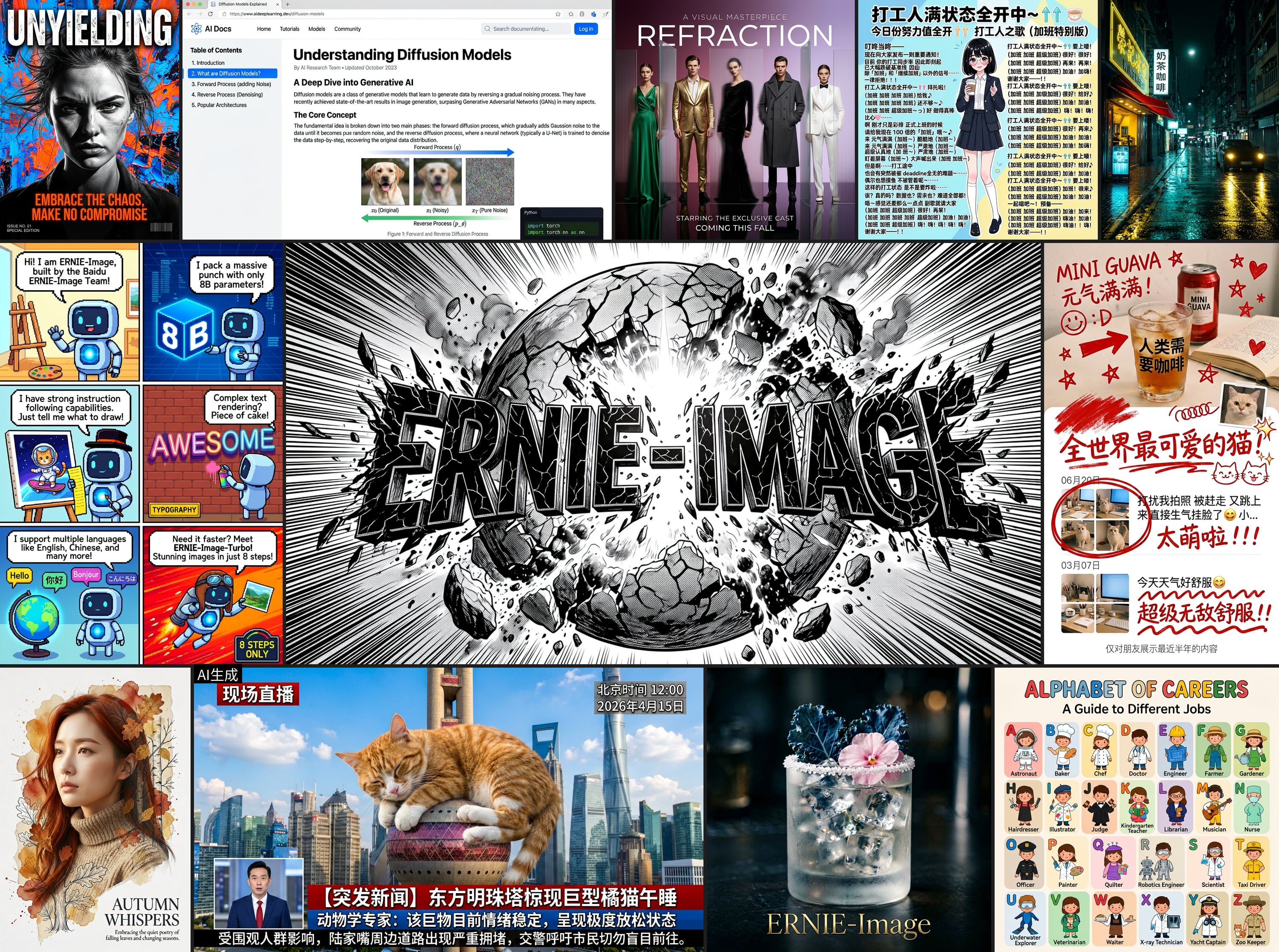
One model, every style
What a single ERNIE Image checkpoint can produce
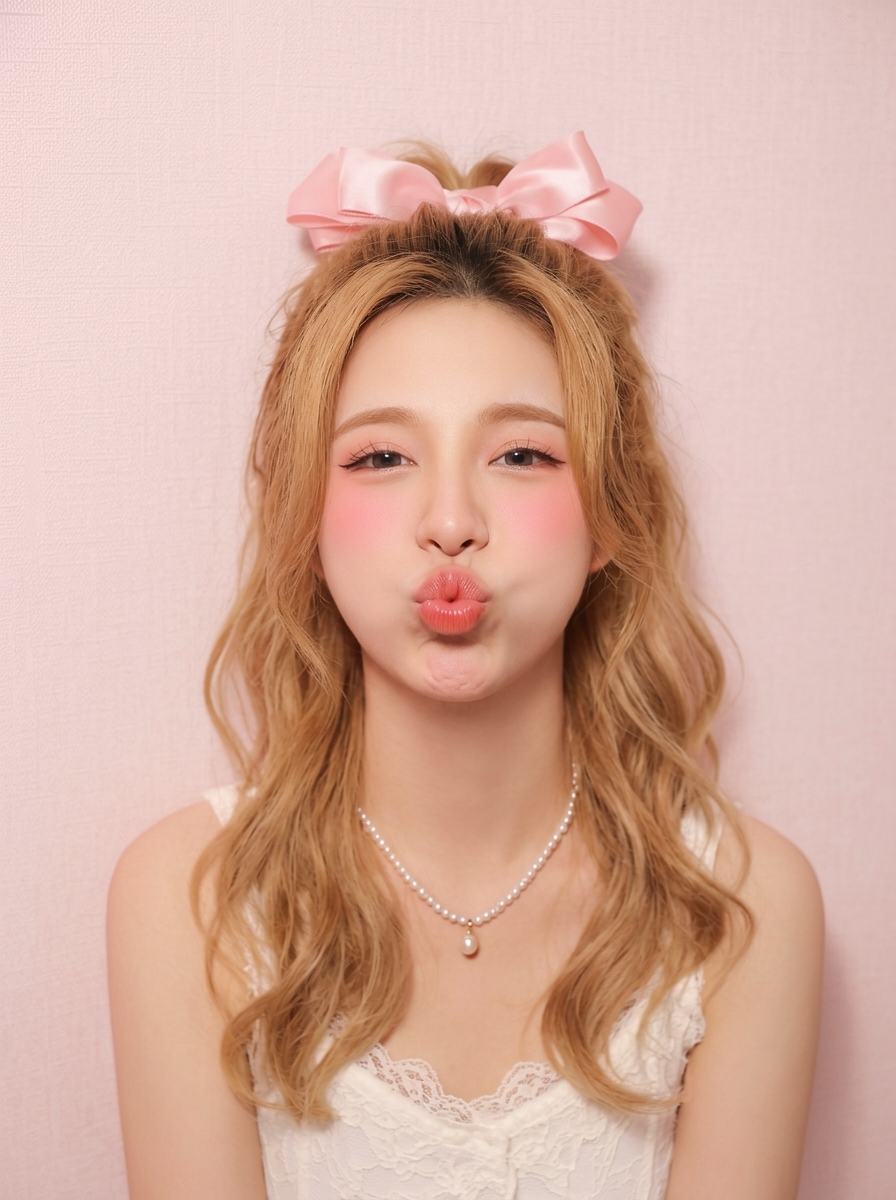
Dense-text posters, comic panels, realistic portraits, stylized illustrations, bilingual signage — all from the same ERNIE Image weights.
How ERNIE Image works
Architecture and inference pipeline
Every figure below is taken from the ERNIE Image public model card and configuration files. Items the model card does not disclose are labeled as such.
Diffusion backbone — ErnieImageTransformer2DModel
The ERNIE Image denoiser is a single-stream Diffusion Transformer (DiT). Its public config exposes 36 layers, a hidden dimension of 4096, an FFN hidden size of 12288, 32 attention heads, and 128 input/output channels. The text conditioning vector is 3072-dimensional.
- Layers36
- Hidden dim4096
- FFN hidden12288
- Attention heads32
- I/O channels128
- text_in_dim3072
Prompt Enhancer — Ministral3ForCausalLM
ERNIE Image ships with a dedicated Prompt Enhancer component. It accepts a short user description plus a target resolution and rewrites them into a richer, structured visual description. Its chat template constrains it to output only the enhanced text, and the pipeline can return the revised prompt for audit and reproducibility.
- ArchitectureMinistral3ForCausalLM
- Hidden dim3072
- Layers26
- Vocab131 072
- Position encodingYaRN RoPE
- Toggleuse_pe
Text encoder — Mistral3Model with Pixtral vision config
The ERNIE Image text_encoder config is not a traditional CLIP text tower. It is a Mistral3Model containing both a text_config and a vision_config. The vision_config declares model_type=pixtral, patch size 14, 24 layers, and hidden dim 1024, with an image_token_index field present — hinting at latent multimodal capability at the config level, though the public model card focuses on text-to-image use.
Inference flow
- 01User prompt, optionally routed through the Prompt Enhancer when
use_pe=True. - 02Tokenizer and text / multimodal encoder produce conditioning vectors of dim 3072.
- 03DiT denoiser samples a latent — ~50 steps for the SFT model, 8 steps for ERNIE Image Turbo (DMD + RL distilled).
- 04VAE decoder maps the latent back to pixels. The pipeline optionally returns
revised_promptsfor audit logs.
What ERNIE Image is good at
Capabilities taken from the official model card
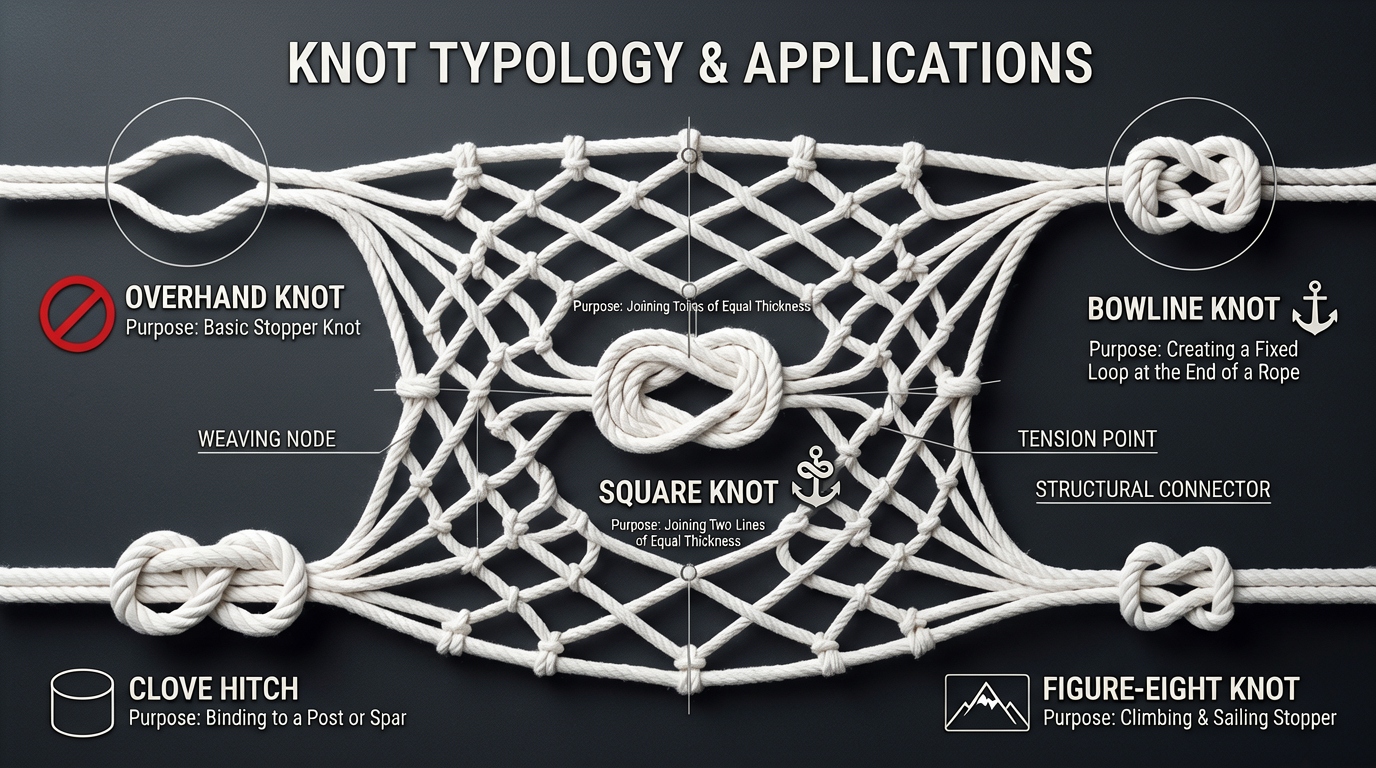
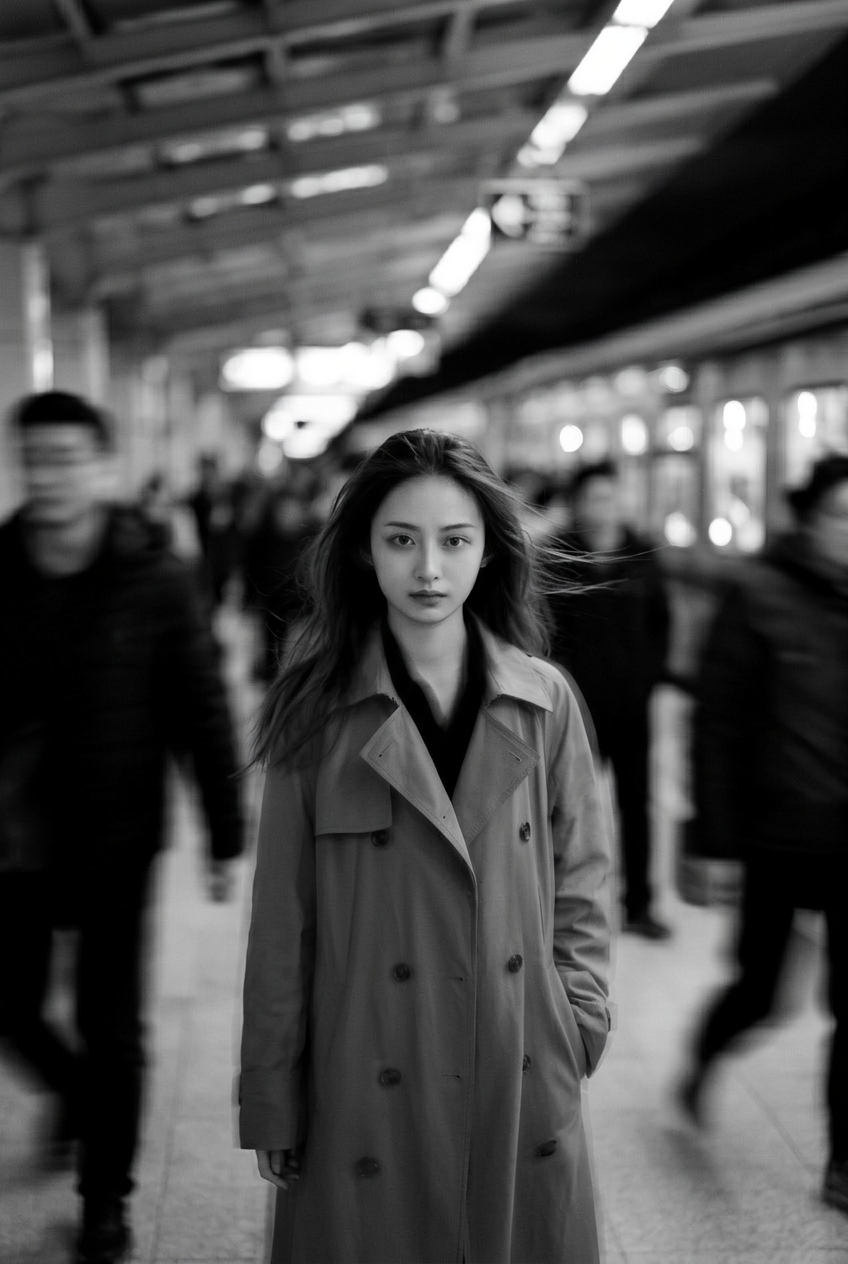
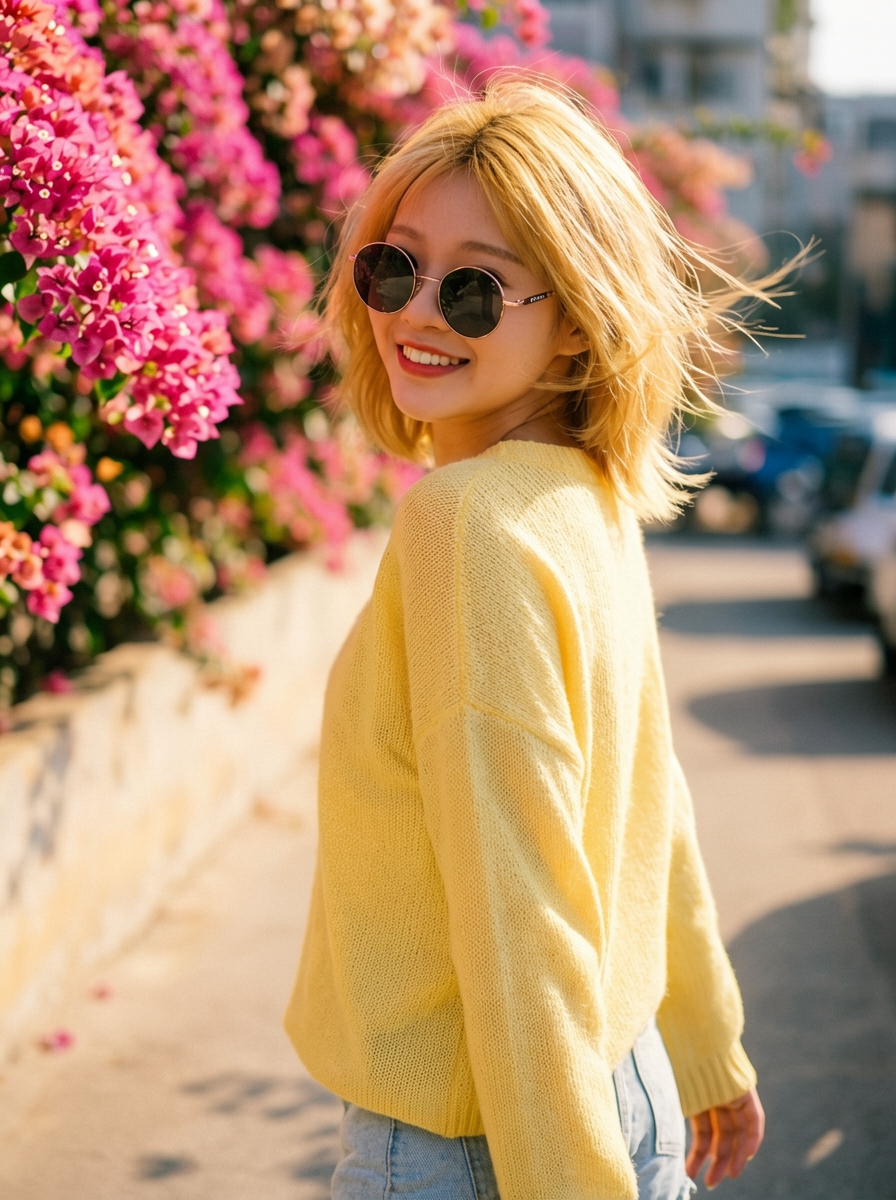
LongTextBench 0.9733
Long-form text rendering
On LongTextBench, ERNIE Image (with Prompt Enhancer) averages 0.9733 across EN and ZH subsets. Multi-line marketing copy, comic dialogue, and labeled infographics stay legible in a single generation — this is the defining strength of the ERNIE Image model versus same-size peers.
GenEval 0.8856
Complex instruction following
ERNIE Image reaches 0.8856 Overall on GenEval without Prompt Enhancer, leading several contemporary open-weight baselines in the published table. It handles prompts with multiple objects, spatial relations, counts, colors, and attribute bindings more reliably than models of comparable size.
OneIG EN 0.5750 · ZH 0.5543
Native Chinese and English
On OneIG-Bench the Chinese and English tracks are close enough to treat as one pipeline. Prompts can be written in English, Chinese, or mixed, and ERNIE Image routes them through the same encoder path.
Structured layouts
Posters, comics, multi-panel
The ERNIE Image model card explicitly positions the model for posters, comics, storyboards, and multi-panel compositions — outputs where text rendering and composition matter at the same time. The architecture is tuned for that class of images rather than single-subject portraits alone.
Benchmarks
Numbers from the ERNIE Image model card
All scores below are copied verbatim from the ERNIE Image Hugging Face model card (evaluated 2026-04-15). Scores are in the 0–1 range; higher is better. Benchmarks drift over time — treat these as a snapshot.
GenEval — top 3
Compositional T2I — object count, position, color, attribute binding
| Model | Overall |
|---|---|
| ERNIE-Image (w/o PE) | 0.8856 |
| ERNIE-Image (w/ PE) | 0.8728 |
| Qwen-Image | 0.8683 |
OneIG-EN — top 3
English track — alignment, text, reasoning, style, diversity
| Model | Overall |
|---|---|
| ERNIE-Image (w/ PE) | 0.5750 |
| ERNIE-Image-Turbo (w/ PE) | 0.5656 |
| ERNIE-Image (w/o PE) | 0.5537 |
OneIG-ZH — top 3
Chinese track — same five dimensions as OneIG-EN
| Model | Overall |
|---|---|
| ERNIE-Image (w/ PE) | 0.5543 |
| ERNIE-Image-Turbo (w/ PE) | 0.5435 |
| ERNIE-Image (w/o PE) | 0.5208 |
LongTextBench — top 3
Long-form text rendering inside generated images
| Model | EN | ZH | Avg |
|---|---|---|---|
| ERNIE-Image (w/ PE) | 0.9804 | 0.9661 | 0.9733 |
| ERNIE-Image-Turbo (w/ PE) | 0.9675 | 0.9636 | 0.9655 |
| ERNIE-Image-Turbo (w/o PE) | 0.9602 | 0.9675 | 0.9639 |
Source: official baidu/ERNIE-Image and baidu/ERNIE-Image-Turbo model cards. Evaluated 2026-04-15.
Honest limitations
What the ERNIE Image model does not do
Prompt Enhancer is a tradeoff, not free quality
Turning use_pe on raises ERNIE Image Counting from 0.7781 to 0.8187 on GenEval, but lowers the Overall score from 0.8856 to 0.8728. The enhancer shifts the model toward richer, more structured descriptions at the cost of some attribute-binding precision. Treat it as a per-scene switch rather than always-on.
Training data is not publicly disclosed
The ERNIE Image public model card does not disclose training dataset sources, licensing terms, scale, language mix, or synthetic-data fraction. Downstream users who need these details for compliance should treat them as unknown and design their own filtering and auditing layer.
Benchmark drift is real
GenEval 2 research flags that popular text-to-image benchmarks drift as models saturate and evaluators age. ERNIE Image scores here reflect the scripts and evaluator versions used on 2026-04-15. A re-run on a newer evaluator is likely to produce different absolute numbers even without model changes.
Understanding tasks are out of scope
The ERNIE Image model card focuses on text-to-image generation. It does not claim image captioning, visual question answering, or document understanding. Pipelines that need those capabilities should compose ERNIE Image with a separate vision-language model.
ERNIE Image — frequently asked questions
Who built the ERNIE Image model?+
ERNIE Image is developed by the ERNIE-Image Team at Baidu and released on 2026-04-15 under the Apache 2.0 license. Open weights are distributed on Hugging Face at baidu/ERNIE-Image and baidu/ERNIE-Image-Turbo, with reference code at github.com/baidu/ernie-image.
What is the difference between ERNIE Image and ERNIE Image Turbo?+
Both share the same 8B single-stream Diffusion Transformer backbone. The SFT ERNIE Image model samples in ~50 steps at guidance 4.0 and gives slightly higher Overall on GenEval. ERNIE Image Turbo is distilled with DMD and reinforcement learning to 8 steps at guidance 1.0 — roughly 6x faster — and is what the free generator on this page runs.
How good is ERNIE Image at rendering long text inside images?+
On LongTextBench, ERNIE Image (with Prompt Enhancer) averages 0.9733 across EN and ZH subsets, and the Turbo variant averages 0.9655. Multi-line marketing copy, comic dialogue, and labeled infographics stay legible — the defining capability of ERNIE Image relative to same-size peers.
Does ERNIE Image handle Chinese prompts as well as English?+
Yes. On OneIG-Bench with Prompt Enhancer, ERNIE Image scores 0.5750 on the English track and 0.5543 on the Chinese track — a small gap compared to most open models. Prompts can be written in English, Chinese, or mixed, and ERNIE Image routes them through the same encoder path.
When should I turn the Prompt Enhancer off?+
The Prompt Enhancer trades off dimensions: enabling it raises GenEval Counting from 0.7781 to 0.8187 on ERNIE Image but lowers the Overall score from 0.8856 to 0.8728. Turn it on for detail-rich or structured scenes where richer descriptions help, and off for strict attribute-binding prompts where precision matters more than elaboration.
What image resolutions does ERNIE Image support?+
The ERNIE Image model card documents 1024×1024, 848×1264, 1264×848, 768×1376, 1376×768, 896×1200, and 1200×896 — enough for posters, storyboard panels, UI mockups, and widescreen scenes without cropping.
Can ERNIE Image run on a consumer GPU?+
Yes. The ERNIE Image public model card states the 8B DiT runs on a single 24 GB consumer GPU. Community reports on Baidu AI Studio also discuss 16 GB local setups, though those should be validated against the official reference implementation before relying on them.
What is not publicly disclosed about ERNIE Image?+
The model card does not disclose training dataset sources, licensing provenance, dataset scale, synthetic-data fraction, alignment reward models, or red-team results. Deployments with compliance requirements should treat these as open questions rather than infer them.
Sources and references
Every factual claim on this page is grounded in the following first-party and peer-reviewed sources.
Official — Baidu / Hugging Face
About this page
ernie-image.org is an independent reference and live-demo host for the ERNIE Image model released by the ERNIE-Image Team at Baidu on 2026-04-15. This site is not operated by Baidu. Every technical figure, benchmark number, and architectural claim on this page is sourced from the official ERNIE Image Hugging Face model card, the ERNIE Image GitHub repository, and the linked peer-reviewed benchmark papers.
Where the ERNIE Image model card does not disclose a figure — training data, alignment details, safety evaluation — this page labels it as such rather than inferring it. Benchmark numbers are snapshots from 2026-04-15 and will drift as evaluator versions evolve.
Content last updated: 2026-04-15.